Kikimora
Kikimora is a malevolent household spirit in East‑Slavic folklore, often depicted as a tiny, hunch‑backed woman with a thimble‑sized head who lives behind the stove and meddles with spinning, weaving, and nighttime noises. She harms livestock, breaks dishes, and torments sleepers, and traditional protections include hanging a pierced stone or juniper branches above the hen perch. Legends say she originates from unbaptized infants, aborted fetuses, or malicious craftsmen who placed a crafted doll in the home to curse its occupants.
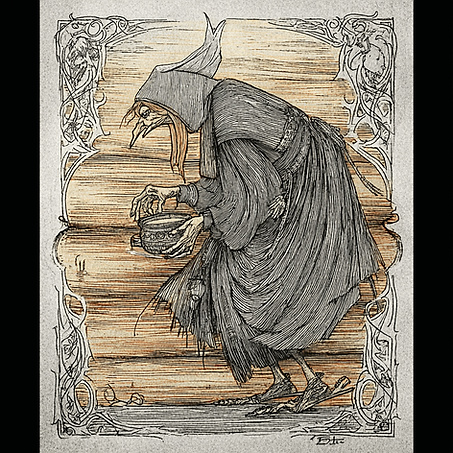
"The people gave it the nickname “Chortovo Logovishche,” and superstitious legends filled it with terrifying kikimoras and horned leshys."
M.Y. Lermontov, “Vadim,” 1834
Domestic Shadow Figure
House Spirit
Kikimora (also called shishimora, susedka, mara) is one of the varieties of the domovoy. This figure of East‑Slavic mythology is a manifestation of the evil spirit Mara – Kiki‑Mara.
The presence of a kikimora in a house could easily be identified by wet footprints. There is also a swamp (or forest) kikimora, the wife of the leshy (leshachikha), who lives in the forest or swamp (swamp kikimora, forest kikimora). She is described as a small, hunch‑backed, ugly old woman dressed in rags, untidy and eccentric. She was accused of kidnapping children, leaving in their place an enchanted “poleshko.”
A Night Demon
Mara is a pan‑Indo‑European name for a nocturnal demon that inflicts hallucinations and terrible nightmares (hence the term “kosh‑mar”). In European legends Mara sits on a sleeper’s chest, causing suffocation.
Appearance
Kikimora is an evil spirit taking the form of a dwarf or a small woman; its head is the size of a thimble and its body is as thin as a straw. The kikimora lives in the house behind the stove and occupies herself with spinning and weaving, and at night she plays tricks with the household’s spindle and distaff (for example, tearing yarn).
Protective Charms
Kikimora can damage domestic animals, especially chickens; she throws and smashes dishes, disturbs sleep, and makes noise at night. Getting rid of a kikimora is extremely difficult. A protective talisman against her was the “chicken god” – a stone with a natural hole or the neck of a broken jug fitted with a fragment of kumach cloth, which was hung over the perch so that the kikimora would not torment the chickens; juniper, whose bark was used to tie salt‑cellars, was also employed as protection.
Origins
It was believed that infants who died unbaptized become kikimoras. Peasants also thought that a kikimora could be “summoned” by carpenters or stove‑makers while a house was being built, if they wished to harm the owners for any reason. For this purpose the craftsmen fashioned a doll (a figurine of a “kikimora”) from chips and rags and placed it beneath the threshold or in the front corner of the house.
It was also thought that a kikimora is the victim of a woman’s abortion (an unborn child); the more abortions a woman performed, the more kikimoras she produced, and at the moment of the woman’s death all her kikimoras would come to her to draw her soul into infernal realms.
Leshachikhi
Afanasyev, in his work Poetic Views of the Slavs on Nature, also provides information about leshachikhas: “Folk imagination endows them with such huge and long breasts that they are forced to sling them over their shoulders, and only then can they walk and run freely.” The little demon that sits on the leshachikha’s back, sucking at the breast, is concealed and warmed by the long hair of the leshachikha. These women are overgrown, shaggy, and have tangled hair.

"Kikimora" by I. Bilibin (1934)

Kikimora by T. Hippius