Boris & Gleb
died 1015
Holy right‑believing princes Boris and Gleb (†1015) were the younger sons of Saint Prince Vladimir. Raised in the Christian faith, they chose death over fratricidal war: Boris refused to fight for the throne against his older brother Sviatopolk, and Gleb meekly accepted his fate knowing his brother’s destiny. Boris was slain on the Alta River on July 24, and Gleb was killed near Smolensk on September 5. Their martyrdom affirmed Christian values of mercy and non‑resistance to evil in Rus’. Their relics became renowned for miracles, and they are venerated as heavenly patrons of the Russian land.
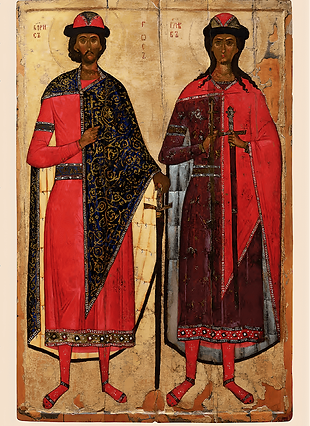
“This pious Boris was of good lineage, obedient to his father, submitting to him in everything. He was handsome in body, tall, round‑faced, broad‑shouldered, slender in the loins, kind‑eyed, cheerful in countenance; his beard was short and he had a moustache—because he was still young. He shone kingly, strong in body, entirely adorned—like a flower blooming in its youth; brave in battle, wise in counsel and discerning in all things, and God’s grace flourished in him.”
The Tale, Suffering, & Praise to the Holy Martyrs Boris & Gleb
Saints of Russia
Saints of
Russia
Boris & Gleb

Boris and Gleb were sons of the great Kiev prince Vladimir Svyatoslavich, the Baptizer of Rus’. Boris was baptized with the name Roman, Gleb — David. It is known that Vladimir had many sons by different wives. The sons did not live peacefully and often fought each other. However, Boris and Gleb were not only brothers by the same father but also by the same mother (a Bulgarian woman) and loved each other. According to the Life of the Holy Brothers, Boris would often read a book—usually lives or martyrdoms of saints—while Gleb sat beside him and listened attentively. Gleb stayed close to his brother because he was still very young. Prince Vladimir favored Boris more than his other sons and trusted him completely.
Early Rule
When Vladimir sent his sons to rule different Rus’ cities, Boris received Rostov and Gleb — Murov. Gleb’s rule in Murom proved difficult. The pagan inhabitants of Murom did not admit him into the city, and the prince had to live outside the walls, in the suburbs.
Vladimir’s Illness & Boris’s Return
In 1014 Vladimir fell gravely ill. He summoned Boris, who hurried to Kiev. It is believed that Vladimir wanted to pass the Kiev throne and authority over his realm to Boris. (At that time Vladimir was at odds with his older sons—step‑son Sviatopolk and Yaroslav.) Soon the Pechenegs attacked Rus’. Vladimir could no longer lead a campaign himself, so he entrusted the army to Boris. The Pechenegs learned that the Kievan forces were moving against them and did not ravage Rus’, retreating homeward. “Boris went out on campaign and found no enemies.”
Vladimir’s Death & Succession

Shortly after Boris left, Vladimir died. His death occurred on 15 July 1015 in the village of Berestove near Kiev. In Kiev Sviatopolk began to reign; later people called him “the Accursed.” In fact he was the son of Yaropolk, Vladimir’s brother, but was born after his father’s death and was adopted by Vladimir. Sviatopolk tried to conceal Vladimir’s death. That night, on his order, a platform was dismantled in the princely hall. Vladimir’s body was wrapped in a carpet, lowered on ropes to the ground, then taken to Kiev to the Church of the Holy Mother of God, where it was buried. Sviatopolk sought the support of the Kievans by lavishly gifting people—clothing to some, money to others. “But the people’s hearts were not with him, but with his brother Boris, with whom the brothers had gone on campaign, the Kievan army,” the chronicler records.
Sources on the Martyrdom of Boris & Gleb
Our knowledge of what happened next comes mainly from three sources: the chronicle tale of the murder of Boris and Gleb, the “Tales of the Saints” by an unknown author, and the “Readings on the Holy Martyrs Boris and Gleb” written by the famous Nestor. Although these monuments differ in some factual details, they agree on the assessment of the brothers’ heroic deed, as they voluntarily renounced worldly political struggle in favor of fraternal love.
Boris’s Return to Kiev & Refusal of Power

Boris, having found no Pechenegs, turned back toward Kiev. On the bank of the small river Alta, a tributary of the Trubezh southeast of Kiev, he received news of his father’s death and Sviatopolk’s accession. Boris wept for his parent; his retinue said to him, “Your army is in despair. Go, sit on your father’s throne!” Boris commanded up to eight thousand well‑armed and trained warriors, and he could certainly have seized Kiev and expelled Sviatopolk. Yet Boris refused to fight for power. The chronicle and the Life record his words: “I will not raise my hand against my elder brother. Though my father has died, this (i.e., Sviatopolk) will be to me as a father.” Hearing this, the army abandoned him. Thus Boris remained on the Alta field with only a few of his retainers.
Sviatopolk’s Plot Against Boris
Sviatopolk began to think of how to eliminate his brother. First he sent a deceitful letter proposing friendship: “Brother, I wish to live in love with you, and I will add to what our father gave you!” That night, secretly, he went to Vyshhorod, a town near Kiev, to meet the Vyshhorod boyars (Sviatopolk had spent some time there during his father’s life and had won their support). “Are you wholly loyal to me?” he asked the boyars. “We can lay down our heads for you,” they replied. The chronicle and the Life of the martyr princes name these boyars—future villains and assassins—as Putsya, Talez, Yelovit (or Yelovich), and Lyashko. “And they are demons, for such are the servants of the devil,” adds the chronicler. “Sviatopolk said to them, ‘Tell no one, go and kill my brother Boris.’ They promised to carry out the deed soon.”
Boris’s Martyrdom & Death

On the day the army left Boris, it was Saturday. In sorrow and grief, Boris entered his tent, wept, and cried out: “Do not look upon my tears, Lord, for I trust in You! May I receive the fate of Your servants and share the lot of all Your saints, for You are a merciful God!” He already knew an assassination was being prepared, as a messenger from Kiev arrived with secret, threatening news. In the evening Boris ordered Vespers, prayed with a priest, and then slept, dreaming of deep sorrow. At dawn he rose, saw it was Sunday, and ordered Matins, praying himself.
Messengers sent by Sviatopolk approached the tent that night, but hearing the saint’s prayer they hesitated. Then Boris sensed a sinister whisper around his tent and realized assassins were coming. “And his tears flowed from his eyes.” The priest and a young attendant looked at the saint, seeing him enveloped in sorrow, and themselves wept bitterly.
The assassins broke into the tent like wild beasts and pierced the holy man’s body. One of Boris’s young attendants, a Hungarian named George, fell on the saint’s body to protect him; they also killed George. George had been beloved by Boris, and the ancient hagiographer notes that Boris once placed a golden diadem—a neck ornament—on him as a sign of affection.
The killers also slaughtered other young attendants. They tried to remove George’s golden diadem but could not; instead they beheaded George and threw his head away, taking the precious ornament.
According to the chronicles, Boris did not die immediately. When the killers, believing him dead, began looting, he found strength and sprang from the tent. “What are you standing and looking at? Let us finish what we have been ordered!” shouted one of the assassins, perhaps the cold‑blooded one. “My brethren, dear and beloved!” Boris pleaded, “Wait a moment, let me pray to my God!” He again addressed the Lord, begging for mercy.
He looked at the assassins with compassionate eyes, his face waned, tears streaming, and said: “Brothers, finish the task given to you. And may peace be to my brother and to you, my brethren!” Then one of the killers approached and struck him in the heart.
Boris’s death occurred on Sunday, 24 July. His body was wrapped in a tent, placed on a cart, and taken to Kiev.
Another version exists: the chronicle and the “Tale of the Saints” say that Boris was killed later, on the road to Kiev. “When they were on the hill, he began to raise his holy head. The accursed Sviatopolk learned that Boris still breathed and sent two Varangians to finish him. They came, saw he was still alive; one drew his sword and pierced him in the heart.”
Thus the blessed Boris perished. His body was secretly taken to Vyshhorod and buried in the Church of Saint Basil.
Plot Against Gleb

Having murdered Boris, Sviatopolk could hardly stop. To retain power without further bloodshed, he could not. He sent a false message to Gleb: “Come quickly. Father calls, he is gravely ill.” Gleb, unaware of his father’s death (now it becomes clear why Sviatopolk concealed it), obeyed as a dutiful son, mounted his horse with a small retinue, and set out. While crossing the Volga, his horse stumbled in a ravine and injured its leg—an ominous sign.
By then Prince Yaroslav of Novgorod, ruling there, learned from his sister Predslava of Vladimir’s death and of Sviatopolk’s murder of Boris. Without delay Yaroslav sent word to Gleb: “Do not go to Kiev; your father has died and your brother Boris was slain by Sviatopolk!” Yaroslav’s messengers met Gleb at the mouth of the Smida River near Smolensk. There Gleb stopped, overwhelmed by the dreadful news.
Gleb wept bitterly for his father and even more for his brother, and prayed tearfully: “Alas, Lord! I would rather die with my brother than live on this earth. If I could see your angelic face, I would die with you. Why am I left alone? I will not hear your words, my brother beloved, I will not hear your quiet voice. If you are near God, pray for me, that I may also receive such a martyr’s death!”
Gleb’s Martyrdom

At that moment, the assassins sent by Sviatopolk suddenly appeared. They seized the ship on which Gleb was traveling and forced everyone aboard to drop their oars, causing them all to die of fear. Realizing that they intended to take his life, Gleb’s tears poured forth, and he begged the killers with tears.
The author of the “Tale of the Holy Martyr Brothers” inserts into the saint’s mouth words filled with heartbreaking pity for his youth and helplessness. This plea is perhaps the most moving passage in all Old Russian literature: “Do not touch me, my dear brethren! Do not touch me, for I have done you no evil. Spare me, brethren, spare me! What offense have I caused my brother and you, my brethren and lords? Have pity on my youth, have pity, my lords… Do not cut the stalk that has not yet ripened, do not destroy the vine that has not yet grown! This will not be murder, but a cutting of cheese…”
Seeing their cruelty, Gleb knelt and, after praying, said: “Since you have begun, proceed and fulfill all that has been commanded to you.”
Then one of the envoys, the accursed Goryaser, immediately ordered Gleb’s killing. He took a knife belonging to Gleb’s cook, named Torchin, and slaughtered the prince like an innocent lamb. This murderous act occurred on 2 September 1015. Thus Prince Gleb died. His body was thrown onto a shore and lay there unnoticed for a long time, between two piles, untouched by beast or bird. Many years later, by order of Prince Yaroslav, the relics of Saint Gleb were moved to Vyshhorod and placed in the Church of Saint Basil, next to his brother Boris’s body. Thus the bodies of the two martyr princes were reunited, as had previously united their souls in heaven.
Further Violence by Sviatopolk

Later Sviatopolk killed another brother—Sviatoslav. “He began to contemplate killing his other brothers and to possess all the Rus’ land for himself,” the chronicler notes.
However, his reign was short. Prince Yaroslav, gathering an army of Novgorodians and hired Varangian mercenaries, marched on Kiev and expelled Sviatopolk from Rus’. The war between them lasted four years (1015–1019) and involved Scandinavians, Poles, Hungarians, and Pechenegs. The decisive battle between Sviatopolk, leading a huge Pecheneg host, and Yaroslav took place in 1019 on the river Alta—the very spot where Saint Boris was slain. According to the chronicler, before the battle Yaroslav raised his hands to heaven and exclaimed, “The blood of my brother cries out to You, Lord! Avenge the blood of the righteous as You avenged the blood of Abel.” Yaroslav also appealed to the saintly brothers: “My brothers! Though you have departed in body, aid me with prayer against this enemy—murderer and haughty one.” The bloody combat lasted the whole day, with three clashes of armies, and only by evening did Yaroslav achieve victory.
Sviatopolk’s Flight & End
Sviatopolk fled the battlefield. As the chronicler and the author of the “Tale” recount, while fleeing he fell ill, became weak, unable to mount a horse, and was carried on a stretcher. He urged his servants: “Run faster! Run! They are chasing us! They are almost upon us!” Yet his servants looked back, and no one pursued them. Unable to stay in one place, Sviatopolk ran across the Polish lands until he reached a desolate spot where his wicked life ended. A grave there exudes a foul stench. “All this was arranged by God as a lesson to Russian princes—if they repeat such deeds, they will receive the same punishment, even greater.”
Veneration of Boris & Gleb
Boris and Gleb were the first Russians officially glorified among the saints. Their veneration began already under Prince Yaroslav Vladimirovich, when miracles began occurring at the martyrs’ tombs: the blind regained sight, the lame began to walk. On 2 May 1071, under Kiev’s Prince Iziaslav Yaroslavich, the relics of both brothers were transferred to a new church. Likely from that time the universal church celebration of the saints was established.
From a rational standpoint, the brothers’ deaths seem senseless. They were not martyrs for the faith in the strict sense. (The Church honors them as “passion‑bearers”—a rank of sanctity unknown in Byzantine hagiology.) Yet the holy brothers accepted death as an expression of boundless love for Christ, imitating His crucifixion. In the consciousness of the Russian people, their martyrdom seemed to atone for the sins of the entire Rus’ land, which had only recently emerged from paganism. Through their lives, the eminent Russian writer and historian G. P. Fedotov wrote, “the image of the meek and suffering Savior entered the Russian people’s heart forever as the most cherished relic.”

Therefore they became perhaps the most revered saints in Rus’. They were called “the native patrons of the Rus’ land.” Their unseen presence stood before princes when they committed wrongful deeds: invoking the saints Boris and Gleb freed innocent prisoners and sometimes halted bloodshed between rival princes. Centuries later, when enemies attacked Rus’, the image of the saintly princes, ready to accept death voluntarily, helped the people endure. In visions and prophetic dreams they appeared before defenders of the Fatherland, ready to assist their “kinsmen”—the Russian princes. This occurred before the Battle of the Neva in 1240 and before the great Battle of Kulikovo in 1380.
Feast Days
The memory of Saints Boris and Gleb is celebrated on 2 (15) May and 24 July (6 August). The feast of Saint Gleb is also observed on 5 (18) September.