
Ivan Kupala
The Kupala celebration marks the summer solstice with bonfires, folk dances, and rituals such as jumping over the flames and swimming in rivers to purify and attract good fortune. Participants also weave floral wreaths, sing traditional songs, and perform symbolic acts—like burning effigies—to honor the ancient Slavic spirit of light, fire, and renewal.

Mythological Figure
Kupala is a mythic personification of the summer‑solstice feast, embodying the ancient Slavic spirit of fire, water, and fertility that later merged with the Christian celebration of Saint John the Baptist.

Christian Adaptation
Ivan Kupala, celebrated on June 24, merges the pagan summer‑solstice festivities with the Christian feast of John the Baptist, featuring bonfires, water rites, and folk rituals that honor both the saint and the ancient spirit of renewal.

Magical Fern-Flow
In Slavic folklore the mystical fern‑flower is said to bloom for a single instant on the night of Ivan Kupala, and whoever plucks it gains hidden knowledge and the promise of untold treasure.
Mythological Kupala
Kupala (Kupalo) is a mythological character among the Eastern Slavs, the personification of the summer‑solstice holiday — Ivan Kupala. The name Kupala derives from the name of the holiday. In folk tradition Kupala denoted a rag or straw doll (effigy) that was burned or drowned during the Kupala festivities (on the night of St John the Baptist, 24 June old style, before the accumulated lag of the Julian calendar; the summer solstice is one of the critical points of the yearly cycle).
Christian Adaptation
Christianity adapted to the agrarian Slavic holiday, linking it with the name of John the Baptist (hence Ivan’s Day).
Literary Origins
Kupala as a deity owes its appearance to the literary tradition. Among truly ancient Slavs such a deity did not exist. The first mention of this “deity” dates to the 17th century. “To this Kupala, the demon, even today in some lands, mad memories are performed, beginning on June 23, in the evening of the birth of John the Forerunner, even until the harvest and beyond …” reports the Gostynska Chronicle.
In the message of the igumen of the Pskov Eleazarov Monastery Panfil it is said that “witches” — men and women — wander the meadows, swamps, forests, fields, allegedly seeking some mortal herbs “to the detriment of man and cattle.” And on the very feast of John the Forerunner, coinciding with the summer solstice, “on that holy night almost the whole town will rise up, and in villages they will beat drums, and blow horns, and with stringed instruments, and with all sorts of unseemly unholy games, splashing and slapping; to women and girls and heads they will nod, and with their mouths they will chant hateful chants, all vile demonic songs, and with their throats they will howl, and their legs will gallop and stamp; the same is a great fall for men and boys, the same is a lewd wandering for women and maidens, likewise there is defilement for married women and indulgence for girls.”
Poetic Folk Rites
The ancient folk rites connected with the culminating mystery of the solar circle — the holidays of Kupala and Kolyada — are extraordinarily poetic. The name Kupala in Sanskrit meant “to shine,” “to glitter.” Hence “kupavy” — white, “kupat” and “kipet” — the connection of fire with water.
Kupala is a festival of light and fire; Kupala customs include going to the sauna and lighting bonfires. In general the day of Kupala is not only a universal celebration of enjoyment, when the family dissolves into the community, but also a worldwide festivity of the elements and celestial bodies, and the person, merging with nature, strengthens himself with its mighty power and is reborn in its mysterious, fruitful life.
Purification & Ablutions
On this day the ancient Slavs dispelled all impurity: they burned the shirts of the sick to destroy disease, washed themselves with dew so that illness would not trouble them, lit bonfires and leapt over them so that the sacred fire would cleanse a person of all malice.
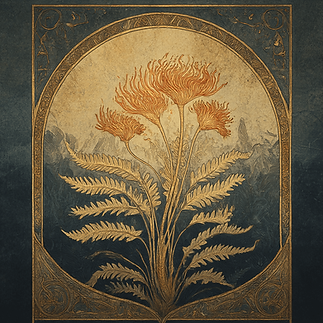
Fern-Flower of Perun
Eastern Slavs believed that on the shortest night of the year the fern blooms, and if a person manages to pluck the blooming fern, he will find treasure. This belief was linked to the idea that everything blooms on Ivan’s night (the notion of the earth reaching “full strength”), but only one plant did not bloom — the fern. This was because the fern does not flower; however a plant cannot fail to flower, since the peasant knows that reproduction proceeds through the flower. Therefore the fern does flower, and it flowers precisely when everything else does — on Ivan’s night; it is only important to catch that moment.
Folk legend says that exactly at midnight, under thunder and storm, the fiery flower of Perun blossoms, spreading bright light all around like the sun. The flower, however, displays only for a brief instant—you do not have time to blink before it flashes and disappears. Whoever wishes to obtain the fern’s flower must, on the preceding day, go into the forest taking a tablecloth and a knife, then locate a fern bush, draw a circle around it with the knife, spread the tablecloth, and, sitting within the circle, keep his eyes fixed on the plant. As soon as the flower ignites, one must immediately pluck it and hasten home, covering oneself with the tablecloth. At home, using the same knife, cut a finger or palm and insert the flower into the wound; then all hidden knowledge will be revealed to the person.
Unclean forces interfere in every way with plucking the flower. Near the fern on the night when it should bloom lie snakes and various monsters that vigilantly guard the minute of its flowering. Upon the brave one who decides to seize the flower, the unclean force induces a sleepless stupor, attempts to bind him with fear. And as soon as he plucks the flower, the earth immediately begins to tremble beneath his feet, thunder strikes, lightning flashes, winds howl, fierce cries are heard, gunfire, demonic laughter. The man is enveloped in hellish flame and a suffocating sulphuric odor. Before him appear beast‑like creatures with enormous tongues protruding, the sharp tips of which pierce straight to the heart.
Until you obtain the fern’s flower, you must not leave the circle or glance to the sides: if you turn your head it will remain turned forever, and if you step even a single step out of the circle, demons will tear you to pieces. When you pluck the flower, you must grip it tightly in your hand and run home without looking back; if you look back, everything will vanish. The closed circle serves as a barrier that the unclean force cannot cross. A knife, a candle, a rowan stick, a splinter symbolize lightning striking demons, and the tablecloth represents a cloud cover; covered by it a person becomes invisible.